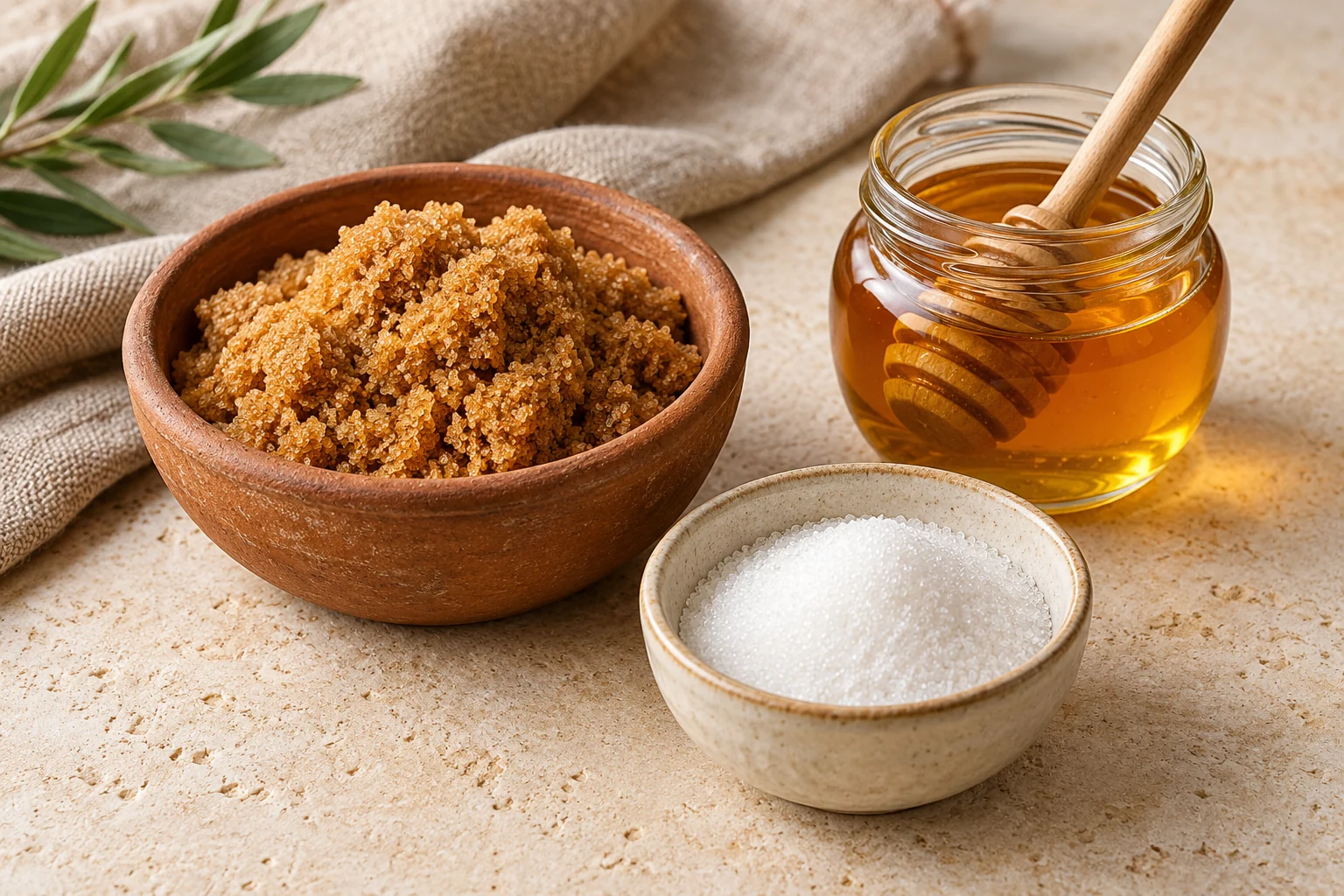
A recipe line that says “packed brown sugar” contains an instruction as well as an ingredient. The quantity refers to sugar measured in that condition. Removing the word packed changes the meaning of the line, even if the cup quantity stays the same.
Before converting, read the entire line and choose a reference with the same preparation. This small check matters more than showing a result with several decimal places.
Read the preparation as part of the amount
Packed describes how the sugar occupies the measure. A loosely filled cup and a packed cup are different conditions. A conversion reference for one should not be reused for the other simply because both contain brown sugar.
Keep the wording that the recipe actually uses. If it distinguishes light and dark brown sugar or gives a particular product, retain that detail too. Do not shorten the row so far that the person cooking can no longer tell which ingredient and preparation were intended.
Choose a matching reference
On the brown sugar page, check the selected source, preparation, and original measure. King Arthur’s weight chart includes a packed brown sugar reference. Its stated weight belongs to that reference; it is not a promise about every way of filling every cup.
A source cup and a defined metric or US customary cup must remain distinct unless the source establishes their relationship. Changing the cup setting should not quietly change which measurement method you are following. If the tool cannot support the selected combination, resolve it rather than borrowing a nearby value.
When the recipe already gives grams
A recipe with a stated gram amount can be scaled directly. Suppose the original recipe uses 140 g of brown sugar for four servings and you need six. The multiplier is 6 ÷ 4, or 1.5, so the new amount is 210 g.
That example is a serving calculation, not a cup-weight claim. You do not need to select a new density to multiply a mass by a serving ratio. Keep any preparation note in the recipe because it may still matter to the method, but do not introduce a cup conversion unnecessarily.
| Original servings | Target servings | Original amount | New amount |
|---|---|---|---|
| 4 | 6 | 140 g | 210 g |
If the preparation is unclear
A pasted line may say only “brown sugar.” You can keep its stated grams, or scale a cup quantity within its original unit, without pretending that the preparation is known. A weight-to-volume conversion needs a further choice.
Look for the recipe’s measuring instructions or an ingredient note. If you cannot resolve the condition, keep the original measure or add your own measured relationship. Do not label a guess “packed” just to make a converter produce an answer.
Keep useful detail on the shopping list
Brown sugar can appear in more than one part of a recipe. Quantities can be combined when they refer to the same ingredient, the same preparation, and compatible units. If one row is packed and another is unresolved, keep the distinction until you decide how the rows relate.
A shopping total does not replace the recipe’s instructions. Preserve notes about where an amount is used, especially when some sugar belongs to a topping and the rest to a filling. The total helps you gather ingredients; the original rows help you use them in the right places.
Before you put the number to work
Confirm the ingredient and preparation, check the selected source measure, and keep the original amount visible. If you change the number of servings again, recalculate from that original amount instead of multiplying a rounded display.
This approach gives you a quantity you can trace back to a clear choice, along with the context needed to repeat it.