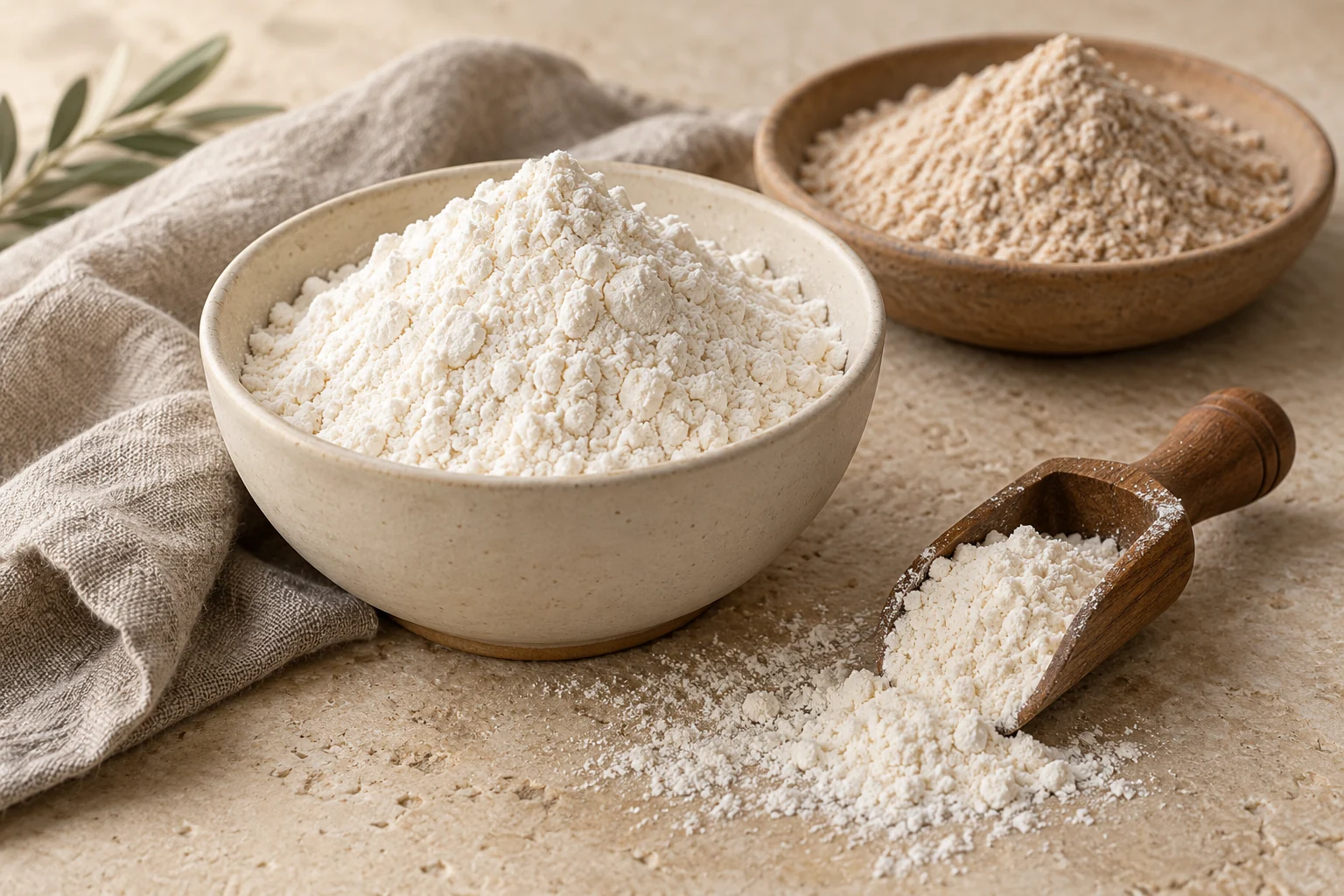
You can fill the same measuring cup twice and get different amounts of flour. A cup tells you how much space you have filled; it does not, by itself, tell you how much flour is inside.
A useful conversion therefore keeps three details together: the ingredient, the way it was measured, and the reference behind the number. Once you can see those details, it is easier to decide whether the result fits your recipe.
What a cup measures
Volume measures the space an ingredient occupies. Mass measures the quantity recorded by a scale. Flour can settle or become compacted, so the amount that fits into a cup changes with the way you fill it. The cup has not changed; its contents have.
This is different from converting grams to kilograms. Both of those are units of mass, so the relationship is fixed. Moving from a flour cup to grams crosses between volume and mass and needs an ingredient reference.
Keep the measuring method
Follow the method stated by the recipe or the reference you are using. For the King Arthur all-purpose flour reference, the method is to loosen the flour, fill the measure lightly, and level the top. Packing the flour into the cup would describe a different measurement.
Keep a short method note with the ingredient row. “Lightly filled and level” is much more useful than a bare cup quantity when you return to the recipe later. A note is also helpful when another person is preparing the ingredients.
Loosen
Loosen the flour in its container before filling the measure.
Fill lightly
Let the flour fall into the dry measure without pressing it down.
Level
Remove the excess across the rim, following the source’s method.
A source-based example
King Arthur lists 120 g for its cup of all-purpose flour. BatchLadle can use that reference for a quantity expressed in the same source measure. One and a half of those source cups gives an approximate weight of 180 g.
The arithmetic can be precise while the underlying kitchen reference is approximate. That is why the result carries an approximate sign and retains the name of the source. Extra decimal places would not make the original measurement more certain.
| Source quantity | Reference result |
|---|---|
| 1 source cup | Approximately 120 g |
| 1½ source cups | Approximately 180 g |
Check which cup the source means
A publisher’s use of the word “cup” does not automatically establish a volume in millilitres. If the consulted reference does not define that volume, its cup remains a source measure. Do not silently relabel it as a US customary or 250 mL metric cup.
When you need another cup system, choose a reference that explicitly supports it. If no suitable reference is available for the ingredient and preparation, keep the original measure or use a measurement you have made yourself.
Keep the original weight when you have one
If your recipe already gives flour in grams, enter those grams directly. Converting them to a cup estimate and back adds a dependency that the recipe did not need. You can still scale the amount to another number of servings.
For example, changing a recipe from six servings to nine multiplies an original 180 g by 1.5, giving 270 g. No flour density is needed for that calculation. The recipe’s cooking instructions remain a separate part of the recipe.
A short check before you convert
Look at the complete ingredient line, including words such as sifted or packed. Then inspect the selected reference and its unit definition. If either detail differs from your recipe, resolve that mismatch before using the number.
After converting, keep the source and method alongside the result. A useful note lets you reproduce the choice; a number without its context cannot do that.
- Match the actual flour type.
- Keep the measuring method with the amount.
- Retain the source unit until another definition is established.
- Use the original weight when the recipe provides one.